The Jackson Purchase region of Kentucky is comprised of the eight westernmost counties - Ballard, Calloway, Carlisle, Fulton, Graves, Hickman, Marshall and McCracken. It is bordered on the west by the Mississippi River, on the north by the Ohio River, on the east by the Tennessee River and the state of Tennessee to the south. By Kentuckians it is generally referred to simply as "the Purchase".

Andrew Jackson and Isaac Shelby purchased the land lying west of the Tennessee River from the Chickasaw tribe and opened the area for settlement around 1820. Within the next few years, my grandfather's ancestors came there from Virginia, North Carolina and Tennessee - the Beadles, Clapps, Pryors and Wingos settled in Graves County with the Reeves and Halls in neighboring Ballard County.

Sunday, November 25, 2012

Pryor Ancestor - Mourning Thomson

James and Jonathan Pryor who settled in Graves County, Kentucky shortly after the area was opened for settlement were the children of Richard Pryor and Mourning Thomson originally from Virginia. Mourning Pryor was named as a daughter in the will of Thomas Thomson of Trinity Parish, Louisa County, Virginia written on 24 April 1774. Thomas Thomson died sometime before the 10th of October 1774 when the will was recorded.


Fanny Pryor,
daughter of Richard Pryor
grandson of Mourning
There has been much confusion regarding the identity of Mourning's mother who was previously listed in numerous online sources as Hannah McAllister. Based upon Thomas Thomson's will her name was Hannah but it appears that it was a Thomas Thomasson of Louisa County who was married to Hannah McAllister daughter of William McAllister (Mackalester) and Elizabeth Garland. Thomas Thomasson was the son of George Thomasson of Hanover County, Virginia. Thomas and several of his brothers moved to Granville County, North Carolina around 1777 where he died testate in 1818.

The identity of Mourning's grandfather, father of Thomas Thomson, previously believed to be Samuel Thomson who died in Louisa County in 1753 has recently also come into question based upon the name of slaves distributed to legatees of that will. This is an area that needs much research into the records of Louisa County to resolve.

Soon after the Revolutionary War ended, the Pryor family settled in the Greene/Cocke County, Tennessee area where Mourning Prier is recorded as being one fo the charter members of the Big Pigeon Primitive Baptist Church when it was constituted on the 6th of December 1787. In February of 1794, Mourning Prier made application for a letter of dismissal which was apparently in preparation for the family's move to Logan County, Kentucky.

Grave of Capt. A. J. Pryor
After their arrival in Logan County, Richard Pryor died in 1797 and Mourning is recorded as the administratrix of his estate. In Logan County on the 19th of June 1800, Mourning Pryor married widower Thomas White whose daughter Elizabeth was the future wife of Jonathan Pryor. When Thomas White died in 1806, Mourning was the executrix of his will.

As Mourning White, she was recorded in the census and tax records of Logan County, Kentucky until after 1810. There are unsubstantiated reports that Mourning, along with Jobe family relatives, attended the Old Mulkey Meeting House (Baptist) near Tompkinsville, Kentucky in Monroe County and that she lived to be past 100 years. There are no historical records that confirm these assertions. I have made several trips to Logan County searching the records as well as local cemeteries there, but was unable to find any further record of Mourning Thomson Pryor White. It seems far more likely that she died sometime before 1820 when her youngest children, James, Jonathan and Jeremiah left Logan County.


Update on Mourning Pryor Thomson White - Mourning Pryor in Callaway County

Picture of Fannie Pryor from the Pryor-Hogue Family Album courtesy of Don Howell of West Kentucky Genealogy.

Saturday, November 3, 2012

Wingo Ancestor - Mary Holt


The mother of Jerman Jeduthan Wingo of Graves County, Kentucky was Mary Holt, daughter of Shadrack Holt and Judith Foster of Nottoway County, Virginia. Mary married Thomas Wingo sometime before September of 1800 when they executed a deed for land on Flat Creek in Nottoway County to her parents. Thomas Wingo had been associated with Shadrack Holt in Nottoway County deeds since 1796 when Shadrack and his son John had conveyed this same fifty-three acre tract to Thomas. Sadly all of the early marriage records of Nottoway County were either vandalized or burned by union forces during the civil war so there is no record of their marriage.

Signatures - 1800 Deed, Wingos to Holts
For many years there was great confusion because two Mary Holts married into the Wingo family. On the 23rd of November, 1783, Thomas Wingo's older brother William married Mary Holt. Obviously the Mary Holt born in 1778 was too young to have been the individual who married William in 1783 but this duplication of names confused many Wingo researchers for a very long time. The mystery was finally resolved by researching the Holt family. The Mary who married William in Amelia County in 1783 was found to be the younger sister of Shadrack Holt. When they married in 1783, her mother Mary Holt, widow of Richard Holt, gave consent for the marriage indicating that she was underage and born after about 1765. William Wingo's step-father John Foster signed the bond for the marriage.

As the county designations changed in the Amelia County area, William Wingo was found in the tax records of Prince Edward County in 1783 and after Nottoway County was formed in 1788, he was recorded in the tax records there in 1791. Sometime before May of 1792, Mary Holt Wingo, wife of William, died, for he married Fanny Shepherd in Prince Edward County on the 8th of May 1792. Shortly after their marriage, William, Fanny and the three young children born to he and Mary Holt Wingo, left Virginia migrating to Spartanburg County, South Carolina as his brother Obediah had done a few years earlier.

It is unlikely that any of these families actually moved from Amelia County. The area that became Nottoway County was originally Nottoway Parish of Amelia County. After the formation of Nottoway, Shadrack Holt is no longer found in the records of Amelia County and all historical records until his death in 1801 are in Nottoway County.

Map of Amelia & Nottoway Counties
To add to the confusion caused by two Marys of the Amelia County Holt family marrying two Wingo sons, Ancestry.com's system has repeatedly listed "hints" suggesting a Mary Holt, daughter of a Samuel Holt and Mary Rowe of New Haven, Connecticut as a wife to Thomas Wingo. I just found that of 34 individuals in Ancestry with Thomas Wingo in their family trees, 15 of those 34 list Mary Holt of New Haven, Connecticut as his wife with one other listing her birth in Tennessee. For anyone interested in genealogy, an understanding of United States geography is a must.


There is a wealth of information regarding our Holt family who came to St. Mary's, Maryland by 1646 and from there spread into Virginia and other southern states at the Holt Family site - A Journey to Christmasville.
UPDATE - I'm sorry but that wonderful Holt site has disappeared from the internet. If anyone is interested in more information on the Holt family, please email me.

Sunday, October 14, 2012

Beadles Descendant - James Luther Slayden

James Luther Slayden
James Luther Slayden was born on the 1st of June 1853, the son of Thomas Allison Slayden and Letitia Ellison Beadles of Graves County, Kentucky. Both the Slayden and Beadles families had migrated from the area of Halifax and Pittsylvania counties in Virginia to the Jackson Purchase shortly after it was opened for settlement.

James was the youngest of their children and growing up in the Jackson Purchase, his early life would have been greatly affected by the Civil War. His oldest brother, Lewis Saunders Slayden, was a Capt. in the First Kentucky Brigade, known as the "Orphan Brigade" of the CSA, but became ill with what was then described as consumption from the constant exposure. He resigned his commission in October of 1862 and returned to Graves County where he died in 1864. The majority of the residents of the Purchase were southerners and their sympathies were primarily with the Confederacy which made the occupation of the area by Union forces for much of the war a distressing and difficult era.

Thomas Slayden died in 1869 after which Letitia took her younger children to New Orleans where they lived in the home of her brother James Nicholas Beadles who was a merchant there. In New Orleans James worked and attended school prior to attending Washington & Lee University in Lexington, Virginia.

Ellen Maury Slayden
In 1876, he moved to San Antonio, Texas where he became a cotton merchant and rancher. On the 12th of June 1883, James Luther Slayden married Ellen McGregor Maury of Charlottesville, Virginia.

He was elected as a Democrat to represent Texas in Congress in 1896. In October of 1910, philanthropist Andrew Carnegie appointed him as one of the original trustees of the Carnegie Endowment for International Peace and for several years he was president of the American Peace Society.

He continued to be reelected for ten succeeding congresses. Future Fleet Admiral Chester Nimitz had originally wished to attend West Point but there were no appointments available. James L. Slayden, his congressman, told him that he had one appointment available for the Naval Academy and that he would award it to the best qualified candidate and the rest is history.

In 1918, he declined renomination to congress after receiving a telegram from President Wilson accusing him of not supporting the administration in regard to the war. The records do not reveal that Slayden actively opposed Wilson or the war effort. He did keep his head in the midst of war hysteria which was very strong at that time.

After his retirement, he divided his interests between an orchard in Virginia, a mine in Mexico and his ranch in Texas.

James Luther Slayden died on the 24th of February 1924 and is buried in the Mission Park South Cemetery in San Antonio, Texas. His gravestone is inscribed - "Member of Congress 1897-1919, One who loved his fellow men and labored for universal peace". I always wonder if it wasn't his childhood in the turbulence of the Jackson Purchase during the Civil War that inspired his dedication to the cause of peace.


For more indepth information regarding the Telegram from President Wilson see Tales of the New World.

Friday, September 21, 2012

Hall Ancestor - Charles Morgan

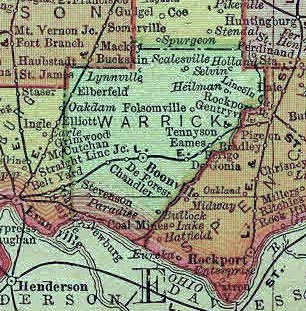
Charles Morgan, grandfather of David Hall and Charles Morgan Hall of Ballard County, is the subject of much speculation and conflicting internet theories. The most factual information available about him comes from the 1832 statement given in Warrick County, Indiana when he filed for a Revolutionary War pension. In that document, he states that he was born around 1757 in Fauquier County, Virginia.

The Charles Morgan who died in Warrick County, Indiana is presumed to be the son of Benjamin Morgan and Phoebe Settle of Fauquier. Benjamin was one of the six sons of Charles Morgan born 28 Sep 1680 in Rappahannock, Virginia. Each of Charles Morgan's six sons named a son Charles. Most of these grandsons are documented and have been correctly identified with their respective parent. Our ancestor Charles Morgan is believed to be the son of Benjamin but there is no documentation to support that. Actually there is currently no documentation that identifies any of the children of Benjamin and Phoebe Settle Morgan.

Much of the conflicting information on the internet originates from the SARRETT/SARRATT/SURRATT Families of America website which would have us believe that this Charles Morgan was the son born circa 1764 in Brunswick County, Virginia to an Anthony Morgan and Mary Wilson. Note that there is no Anthony Morgan recorded in tax lists and other records of Fauquier County. This information does not agree with Charles Morgan's own statements given in his 1832 pension statement and does not appear to have any basis other than proximity due to both individuals living in the area of York County, South Carolina. There were several Charles Morgans in the area around York County and no documentation that deferentiates between them.

Charles Morgan's pension application states that he was residing in York County, South Carolina in 1775 when he volunteered to serve in a militia company. His first service for about three months was in the command of a company of which he was Lieutenant, after which he received a Captain's commission from the Governor of South Carolina. He recalled that he served for three years without intermission. Most of his service was in the command of General Lacy, under whom he had entered the service. He remembered being involved in several skirmishes and a battle of Createn Springs.

He remained in South Carolina for about twenty years after the Revolution, then moved to Kentucky around 1800. There were other members of the Morgan family of Fauquier County, Virginia living in the Logan County area of Kentucky including widowed Phoebe Settle Morgan but that may have no bearing on his choice of the location when settling in Kentucky. He is found in deed records of Logan County in the early years of the 19th century and it is there that his daughter Polly married Archibald Lovelace in 1802. By 1810, he was recorded in Butler County in the census of that year. In neighboring Ohio County, his daughter Susannah married David Hall in 1812 and in Butler County in 1819, daughter Edith Ann "Edy" Morgan married Adam Hall.

It was these daughters and their husbands who came to the Jackson Purchase soon after it was opened for settlement and are all found there by the 1830 census as well as David and Adam's brother James who had married Betsy Lovelace. Charles Morgan's wife, Lorena Arnold, the mother of his older children died in Kentucky about 1816. He married again to Nancy Dixon in 1817 and before his death, he married a third time in 1830 in Warrick County to Mrs. Nancy Camp. He died sometime not long after giving his pension statement on the 18th of September 1832 in Warrick County, Indiana.

This is a lineage that may benefit greatly from the new autosomal DNA projects. It may finally be possible to connect our Charles Morgan to the family of Charles Morgan of Rappahannock or prove that he descended from another of the many Morgan families of colonial America. Autosomal DNA testing could also provide further clues to maternal lines.

Thursday, September 13, 2012

The Mystery of Sarah D. Beadles

Recently I received an email from the husband of a descendant of Sarah D. Beadles suggesting the possibility that she was another daughter of Lewis Yancey Beadles and Martha C. Vaughan. The fact that this family might have included another child that had never been identified hadn't occurred to me before.


Lettisha Wilson Webb
daughter of Sarah D. Beadles Wilson 
After the idea was suggested to me, I looked back over census records of Lewis Yancey Beadles, and in the 1830 census of Pittsylvania County, Virginia, there is a daughter that is never listed in family group sheets or pedigrees. Lewis Y. Beadles' household in 1830 is shown with 3 females still living at home. Daughter Ann had married Jerman J. Wingo in 1826 and was no longer listed in her parents' household, so, based upon previous beliefs regarding the children of Lewis Y. Beadles and Martha C. Vaughan, there should only have been two daughters living at home in 1830. But that was not the case, there was 1 female 15-19 - Letitia, 1 female 10-14 - Mary Elizabeth and 1 more female 5-9. Was this Sarah, born in 1821?

Sarah D. Beadles married Benjamin Franklin Wilson in 1839. The 18th of November 1839 is listed on numerous internet family trees as their wedding date but none cite any source for that date. They apparently married in Kentucky for their first son was born there in 1842. By the birth of their next child, Laura Priscilla, in 1846, the family was living in Tennessee where they're found in the Dukedom community of Weakley County in the 1850 census.

Based solely upon the fact that the family was living in Dukedom, my initial thought was that Sarah must surely have been a descendant of Bassett Beadles, but after some research of that family it doesn't appear so. Bassett Beadles was living in North Carolina until after 1820 when he was recorded in the 1820 Mecklenburg County census. Bassett's children all give North Caroina as their place of birth in later census unlike Sarah whose birthplace is generally recorded as Virginia. In the 1850 census, her birthplace has been transcribed as VT for Vermont, but that is apparently because VA for Virginia was not written clearly. Other census and death records of her children give her birthplace as Virginia.


1870 Census - Cuba, Graves County, Kentucky
1870 Census of Cuba District, Graves County
Sarah and Benjamin F. Wilson named their first son, James Yancey Wilson. The name Yancey is used extensively in the Lewis Yancey Beadles family. His mother was Ann Yancey and her surname was given to numerous descendants as a given name. After James Yancey Wilson married Julia Quisenberry around 1866, they were recorded in the 1870 census living in the Cuba District of Graves County three households from the residence of Jerman J. and Ann Y. Beadles Wingo who was very probably his aunt.

The name of Sarah's daughter, Lettisha, born in 1858, was also used consistently in the Beadles and Vaughan families. The use of the name Letitia seems to have originated in the family of Martha C. Vaughan and dates back at least to the family of her grandfather, Phillip Williams of Gloucester County, Virginia.

The loss of all the records of Graves County prior to 1886 when the courthouse burned may make proving Sarah was another child of Lewis Yancey Beadles difficult, if not impossible, but I believe she is very probably a member of that family. Hopefully some source of documentation that she was the daughter of Lewis Yancey Beadles and Martha C. Vaughan can eventually be found.


(Gravestone photo by Paul R. Wilcox for FindaGrave)

Tuesday, September 11, 2012

A Rare Genealogical Find

William Layne Wingo,
son of John Will Wingo
For those of us who include genealogy and family research among our obsessions, countless hours are spent over a microfilm viewer, in a courthouse, library or other archive searching for a document that will confirm our lineage from a particular ancestor. It's exciting to find a document that confirms one generation, but a document that documents four (4) generations is unthinkable. But here it is - the wonderful document that proves the lineage from my great grandmother, Nancy Susan Wingo Reeves to her great grandfather (my 4th great grandfather) Jonathan Pryor.

Graves County, Kentucky
Deed Book #4, Pg 514

For and in consideration of the sum of sixty dollars cash in hand paid and hereby receipted: we L. W. Wingo and wife, M. M. Wingo, W. A. Jones and wife L. A. Jones (late Wingo), W. L. Wingo, Sidney Reeves and wife N. S. Reeves (late Wingo) and L. T. Wingo, being the heirs at law of Mary F. Wingo the late wife of J. W. Wingo. Who was the daughter of Stacey Clapp deceased; She being a Daughter of Jonithan Pryor deceased; have sold and hereby convey by general warranty to H. C. Allison the following real estate lying in Graves County, Kentuckey: being a one forty fifth (1/45) undivided interest in and to the tract of land set apart by order of the Graves County Court as dower to Mrs. Mary Pryor widow of Jonithan Pryor deceased; said tract of land consists of 206 acres and the interest being conveyed being 1/45 herein subject (undecipherable) to the dower rights. In testimony hereof all said grantors have herewith set their hand; this February 22, 1886.

W. L. Wingo, W. A. Jones, L. A. Jones, N. S. Reeves, S. P. Reeves, L. T. Wingo, L. W. Wingo, M. M. Wingo

Vanzant County; State of Texas: I, L. W. Hayne a notary public duly commissioned and qualified as such in and for the county of Vanzant and State of Texas do certify that this deed from L. W. Wingo and his wife M. M. Wingo and others to H. O. Allison was this day produced to me by the parties which acknowledged by the said L. W. Wingo to be his act and deed; and the contents and effect of the instrument being explained to the said M. M. Wingo by me separately and apart from her husband, she thereupon declares that she did freely and voluntarily execute and deliver the same, to be her act and deed and consented that the same may be recorded. In testimony where of I have here unto set my hand and here with affix my notary seal; this March 1, 1886

W. L. Hayne
J. P. and Exofficio Notary Public
Vanzant County, Texas

It appears that Jonathan Pryor's second wife, Mrs. Mary Wilson Oliver, had died before March 1886 and the portion of his estate that had been set aside for her dower was then reverting to his heirs. The heirs of Mary Frances Clapp Wingo were in turn selling their portions to H. C. Allison, husband of another heir, Louanna Pryor, one of Jonathan's granddaughters.

The only reason this document survived the fire that destroyed the Graves County Courthouse, is because Leonidas W. Wingo was living in Van Zant County, Texas at the time and the document was not located in Graves County at the time of the fire.

You never know what treasures are waiting to be discovered in the courthouse basement.

Saturday, September 1, 2012

Adam Clapp, Soldier of the Revolution

Adam Clapp, the ancestor of the Clapp families of the Jackson Purchase, was the grandson of George Valentine Clapp (Klap) and Anna Barbara Steiss who immigrated from Germany, sailing from Rotterdam on the ship James Goodwill, arriving in Philadelphia on September 27th, 1727. Thanks to the records of the German Reform church now known as the Brick Church founded by George Valentine and his brother John Ludwig Clapp in Guilford County, North Carolina (current Alamance County), this family is extremely well documented.

Adam was born on 10 Dec. 1754 to John Phillip and Barbary Clapp in Orange County, North Carolina. In addition to the records of the Brick Church, Adam applied for a Revolutionary War pension on November 13th, 1832 in Union County, Illinois, providing more information regarding his life and Revolutionary War service. In his affadavit for that pension, he stated that he was living in Guilford County when he first volunteered for service during the Revolution under Capt. Henry Whitesell in the fall of 1776 or 1777. During his first tour of duty they marched to the Cherokee Nation where, along with South Carolina troops and Catawba Indians, they were engaged in a battle. After marching back to Salisbury, they were discharged.

He recalls during subsequent tours of duty, once serving again under Capt. Whitesell at the Guilford Courthouse guarding the public ammunition. When serving under several other commanders on tours after that, they were primarily pursuing the Scotch and Tories in North Carolina. It was after one of these pursuits that they returned to Guilford Courthouse because the British were located there. Joining the main army, they were placed under the command of Gen. Nathaniel Greene. Their arrival at Guilford Courthouse was on the day after the battle took place and they then pursued the British army which was retiring toward New Bern until they were dismissed to return home.

Sometime around 1780, Adam married Emma Ruth Marley daughter of Adam and Rosanna Marley. In his pension statement he says that he moved to Tennessee about five years after the Revolution. By around 1785, Adam is found in the records of Sumner and Robertson counties. After the Revolution, many of North Carolina's soldiers received bounty land grants in Tennessee which was then part of North Carolina.

In Tennessee during the 1790's, Emma Ruth died after which Adam married Ruth Lawrence. He was still living in Robertson County, Tennessee in August of 1804 when he was recorded as serving on a jury there, but by 1807, he and his family had moved to Union County, Illinois. Legend has it that they traveled to Illinois on the Cumberland, Ohio and Mississippi Rivers.

Adam died on August 15th, 1841 and is buried in Union County, Illinois at St. John's Lutheran Cemetery in Dongola. Many of Adam's children remained in Illinois, some migrated to Texas where they were found during the Republic of Texas but the oldest son of Adam and Emma Ruth, John Isaac Clapp, settled in Graves County, Kentucky.