The Jackson Purchase region of Kentucky is comprised of the eight westernmost counties - Ballard, Calloway, Carlisle, Fulton, Graves, Hickman, Marshall and McCracken. It is bordered on the west by the Mississippi River, on the north by the Ohio River, on the east by the Tennessee River and the state of Tennessee to the south. By Kentuckians it is generally referred to simply as "the Purchase".

Andrew Jackson and Isaac Shelby purchased the land lying west of the Tennessee River from the Chickasaw tribe and opened the area for settlement around 1820. Within the next few years, my grandfather's ancestors came there from Virginia, North Carolina and Tennessee - the Beadles, Clapps, Pryors and Wingos settled in Graves County with the Reeves and Halls in neighboring Ballard County.

Showing posts with label Hall. Show all posts

Tuesday, February 25, 2020

The William Hall Family

The name Hall is extremely difficult to research since there are so many different Hall families and our information for William Hall, the father of our ancestor Adam is so scant. If Adam's sons David and Charles Morgan Hall had not been profiled in Kentucky: A History of The State, by W.H. Perrin, J.H. Battle & G.C. Kniffin, published in 1885 we would not have known who his parents were. Thanks to that book with a collection of biographies contributed by individuals still living at the time, we know that Adam's father was William Hall, a soldier of the Revolution, and his wife was Abigail King, both of Virginia.

The first appearance of a William Hall in Logan County, Kentucky appears to be in the tax lists on Drakes Creek in 1797. From 1800 until at least 1813, a William Hall continues to be listed with 245 acres on Drakes Creek. This was initially believed to be William, father of Adam Hall but after a week of searching through the tax, deed and probate records of Logan County it has become clear that this is the William Hall, Revolutionary Soldier, who received a warrant for a 200 acre tract on Whippoorwill Creek in Logan County. These had seemed like two different people until the survey of the Drakes Creek acreage clarified the identity of the William Hall of both surveys. William Hall of the Whippoorwill Creek tract had married Margaret Neely on 25 October 1797 in Logan County. A deed recorded in Deed Book C, pg. 353 conveying the Whippoorwill tract establishes that Margaret was the wife of that William Hall. Additionally the survey of the Drakes Creek land also establishes that was owned by the same William Hall for the survey for that tract names Thomas Neely, probable relative of Margarets and an adjoining property owner as does the deed for the Whippoorwill tract which was sold to Thomas Neely.

After my recent searches of the records of Logan, Butler and Ohio counties, I am convinced that William Hall, husband of Abigail King, died soon after his arrival in Kentucky. The older William Hall of the 1797 tax list may have been him but all of the other listings in the Logan County tax records for a William Hall appear to be William, husband of Margaret Neely. By the 1820 census of Ohio County, Abigail had apparently remarried and may have again been widowed for she is listed as the head of household with the surname Hunter, living in the next residence to those of sons James and Adam Hall.

The 1807 tax lists of Logan County list James and David Hall, each over 21 years of age and with 50 acres. They are listed again in 1808, James with 30 acres on Deer Lick Creek and two other tracks that appear to be rents from individuals named Haws. David is not listed with land in this list but does have three horses. In 1808 younger brother Adam is also listed as under 21 years of age. In both of these years, the Hall sons are listed just below a Peter Hunter which would indicate that they made the trip to the courthouse to pay their taxes together. This raises the question as to whether it was Peter Hunter to whom widowed Abigail Hall was married prior to the 1820 census.

The family was counted in Butler County, Kentucky in the 1810 census. It appears that William Hall was definitely deceased by that year for the 1810 census lists son James as the head of a household that included a male child under 10 years old, 2 younger brothers, 6 sisters (possibly 5 sisters and James' wife) in addition to two older females each over 45 years of age. In 1811 both James and David were listed on the tax lists in Butler County. Again in 1812 they were listed there and joined by younger brother Adam showing a total of 230 acres on the waters of Muddy River. By the census of 1820 the Hall family was found in Ohio County. That census records Abigail Hunter as the head of household with sons James and Adam living in the next residences. David is also present in Ohio County but listed separately.

Adam married Edith Ann "Edy" Morgan, daughter of Charles Morgan and Lurena Arnold (Arendell) on 1 December 1819 in Butler County, Kentucky. His brother David had married Edy's sister Susannah, another of Charles Morgan's daughters, on the 19th of October 1812. All 3 Hall brothers had been listed on the tax lists of Ohio County, Kentucky with land along the Green River in the records there prior to 1820.

It appears that Abigail King Hall Hunter passed away sometime around 1823 for the last tax list that records her in Ohio County was 1822. William Hunter may have been a son or brother of Abigail's second husband. He was obviously of some relation to Abigail's deceased husband and is recorded as a party to various deeds in conjunction with James, David and Adam Hall. One of those deeds even states that it was the land where Hunter, James, David and Adam Hall then lived. Presumably these deeds are in effect selling the lands left to them by their mother, Abigail Hunter, but the intent is not made clear in any of the deeds. In February of 1826 there are several deeds executed by William Hunter who appears to be signing as security on notes or mortgages by the Hall children, Adam, David, James and Polly (Mary) in Ohio County.

After an intense several weeks of research on this Hall family, I still have more questions than answers but at least I've learned a little more about the family. I've also had some significant autosomal DNA matches that could eventually connect our Hall line back several generations. One of the most interesting appears to be DNA matches to an Adam Hall originally of Massachusetts who settled in Adair County, Kentucky bordering Logan. The name of the patriarch of several generations of that family was Adam, which, in conjunction with the DNA match, could be noteworthy. For now this will have to be enough, but the search to find William Hall's origins will continue.

Monday, May 2, 2016

Reeves-Hall Family Bible

Yesterday, I received a wonderful surprise in the form of an email from my Kentucky cousin Donald J. Stewart.  I had asked him some months ago if he knew who currently had possession of the family bible kept by Perlina Hall Reeves, wife of Sidney Preston Reeves of Ballard County.  I knew the bible existed because many years ago, before the availability of copy machines and scanners, my mother had seen it and transcribed some of the information.  At that time the bible was in the possession of Donald's aunt Bonita Reeves Hutcherson.


The bible had descended through Donald's family because the terms of Sidney Preston Reeves' 1881 Ballard County will left the home place and all household goods to his youngest son, David Walter Reeves, Donald's ancestor.  What a benefit to family genealogy that those household goods included the bible and were left to a family member who continued to live in Ballard County.
Perlina Hall Reeves & Sidney Preston Reeves
The bequest to David Walter Reeves is as follows "provided my youngest son David Walter Reeves lives with me during my natural life then at my death I give to him all of my personal property after my just debts all paid provided further that if I should die before my wife Pollina Ann Reeves if my son David Walter Reeves lives with and takes care of his mother Pollina Ann Reeves during her natural life then at her death in addition to the personal property heretofore given him I give him the said David Walter Reeves the homestead containing one hundred & twenty five acres of land heretofore devised to my wife Pollina Ann Reeves during her natural life."  

Dates of birth for Perlina Hall Reeves' siblings are also recorded in the bible in addition to Reeves' family members.  Ballard County's Charles Morgan Hall was a brother to Perlina and is named.


Although the birth dates of Perlina and Sidney Preston Reeves are recorded in the bible, the birthdates of the members of their family begin with their oldest son George Adam Reeves, born February 1, 1840.  


Thanks so much to my cousin Donald for searching for the bible and scanning its pages to share with me.

Thursday, April 14, 2016

Col. Harry Ripley Melton, Jr.

U.S. Military Academy at
West Point - 1936 Yearbook
Harry Ripley Melton, Jr. was the son of Col. Harry Ripley Melton, M.D. a native of Ballard County, Kentucky.  Harry Melton, Sr. was the son of Nannette "Nettie" Hall and French Montcalm Melton. His maternal grandparents were Charles Morgan Hall and Mary Elizabeth Wingo and his paternal grandparents were Henry P. Melton and Mary Ann Sams, all of Ballard County. 

Harry R. Melton, Sr. married Anne Given Rothroth in McCracken County on July 17th, 1909 and their son Harry Ripley Melton, Jr. was born in Ballard County in 1911.

Harry, Jr. was a cadet at the U.S. Military Academy at West Point, graduating in 1936. He initially entered the cavalry but later took pilots' training at Randolph and Kelly Fields in San Antonio, Texas and transferred to the Army Air Corps. While living in San Antonio, he met and married Lavonia Smith and had a daughter, Anne, born October 2, 1938. The couple later divorced and Harry took custody of his daughter Anne. On June 23, 1941 he married Natalie Jean Wilson of St. Petersburg, FL.


During World War II, Col. Harry R. Melton, Jr. was the Commanding Officer of the 311th Fighter-Bomber Group (311th FBG). During his service, he flew the A-36 Apache and later the P-51A Mustang on dive bombing and escort missions over Burma.  On the 25th of November 1943, Harry took off, piloting a P-51A Mustang on a mission to escort bombers over Rangoon in Burma.

Col. Melton fired on and scored three hits on a Ki-43 Oscar piloted by Lt. Yohei Hinoki then performed a split-s maneuver, exposing his belly to Hinoki who opened fire damaging his aircraft. Afterwards, Hinoki broke off his attack to aid his comrades. When leaving the target area, Harry's aircraft began trailing black smoke and lost air speed. Another P-51A piloted by 2nd Lt. Everett Briggs observed him bailing out at 1,000 ft. above the ground then disappeared roughly 100 miles northwest of Rangoon and twenty miles east of the Bay of Bengal. When he failed to return, Col. Melton was officially declared Missing In Action (MIA).

Missing Air Crew Report
He was immediately captured by the Japanese and became a Prisoner Of War (POW). After he was captured, Lt. Hinoki received a telephone call, telling him that they caught a colonel, and asked if he was interested in meeting him, but Hinoki declined although he remembered the name “Melton” and wrote the story in his postwar memoir.

Harry was detained at Burma #5, Moulmein & Rangoon Jail. Later, he was moved to Singapore to be transported aboard a ship to Japan. He was one of 2,200 British and Australian prisoners loaded aboard the Rakuyo Maru departing Singapore on September 6, 1944 bound for Japan. On September 12, 1944 while in the South China Sea off Hainan Island, the ship was torpedoed by the USS Sealion (SS-315) after which she became unable to make way and began to sink. On September 14, 1944, he was in a lifeboat with other POWs when a Japanese destroyer machine gunned everyone in the life boat, including Harry Melton, Jr..

Japanese author and researcher Henry Sakaida who was in contact with Lt. Hinoki recalled that "Hinoki-san was truly saddened by the way Melton died, and politely asked me to see if I could locate the widow. I thought it was a worthy challenge and I accepted. He composed a letter of sympathy and asked that I deliver it. Hinoki-san died in January 1991 of cancer, but I continued my search for 30 years until I located her daughter, Kip, to whom I delivered his letter."

The citation accompanying the posthumous award of the Distinguished Flying Cross to Colonel Melton read as follows:
For extraordinary achievement in aerial flight between 16 October 1943 and 23 November 1943. During this period, Colonel Melton, Commanding Officer of the 311th Fighter Bomber Group, distinguished himself by participating, as pilot, in numerous combat missions over enemy occupied Burma. These flights, consisting of bombing, offensive reconnaissance, ground strafing and escort far over enemy territory, have resulted in the destruction of such enemy material and installations. On one of a series of important missions over Rangoon, the enemy succeeded in destroying Colonel Melton's plane, but it was only when the plane started to burn that he abandoned it deep in enemy territory. That Colonel Melton ordered his wing pilot to join the main formation, instead of following the parachute down, is indicative of the spirit that distinguished him as a flier and as a leader. His activities have constituted an outstanding example of leadership to the pilots and personnel under his command and reflect great credit upon himself and the entire military service.


Col. Harry R. Melton, Sr. was my grandfather's "double cousin". They were related through both the Wingo and the Hall families and grew up together in Ballard County. Col. Melton and Aunt Annie retired in San Antonio and we took my grandfather to see them whenever he visited here. They were lovely and I have very special memories of them.

Friday, September 21, 2012

Hall Ancestor - Charles Morgan

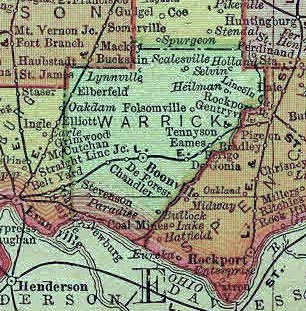
Charles Morgan, grandfather of David Hall and Charles Morgan Hall of Ballard County, is the subject of much speculation and conflicting internet theories. The most factual information available about him comes from the 1832 statement given in Warrick County, Indiana when he filed for a Revolutionary War pension. In that document, he states that he was born around 1757 in Fauquier County, Virginia.

The Charles Morgan who died in Warrick County, Indiana is presumed to be the son of Benjamin Morgan and Phoebe Settle of Fauquier. Benjamin was one of the six sons of Charles Morgan born 28 Sep 1680 in Rappahannock, Virginia. Each of Charles Morgan's six sons named a son Charles. Most of these grandsons are documented and have been correctly identified with their respective parent. Our ancestor Charles Morgan is believed to be the son of Benjamin but there is no documentation to support that. Actually there is currently no documentation that identifies any of the children of Benjamin and Phoebe Settle Morgan.

Much of the conflicting information on the internet originates from the SARRETT/SARRATT/SURRATT Families of America website which would have us believe that this Charles Morgan was the son born circa 1764 in Brunswick County, Virginia to an Anthony Morgan and Mary Wilson. Note that there is no Anthony Morgan recorded in tax lists and other records of Fauquier County. This information does not agree with Charles Morgan's own statements given in his 1832 pension statement and does not appear to have any basis other than proximity due to both individuals living in the area of York County, South Carolina. There were several Charles Morgans in the area around York County and no documentation that deferentiates between them.

Charles Morgan's pension application states that he was residing in York County, South Carolina in 1775 when he volunteered to serve in a militia company. His first service for about three months was in the command of a company of which he was Lieutenant, after which he received a Captain's commission from the Governor of South Carolina. He recalled that he served for three years without intermission. Most of his service was in the command of General Lacy, under whom he had entered the service. He remembered being involved in several skirmishes and a battle of Createn Springs.

He remained in South Carolina for about twenty years after the Revolution, then moved to Kentucky around 1800. There were other members of the Morgan family of Fauquier County, Virginia living in the Logan County area of Kentucky including widowed Phoebe Settle Morgan but that may have no bearing on his choice of the location when settling in Kentucky. He is found in deed records of Logan County in the early years of the 19th century and it is there that his daughter Polly married Archibald Lovelace in 1802. By 1810, he was recorded in Butler County in the census of that year. In neighboring Ohio County, his daughter Susannah married David Hall in 1812 and in Butler County in 1819, daughter Edith Ann "Edy" Morgan married Adam Hall.

It was these daughters and their husbands who came to the Jackson Purchase soon after it was opened for settlement and are all found there by the 1830 census as well as David and Adam's brother James who had married Betsy Lovelace. Charles Morgan's wife, Lorena Arnold, the mother of his older children died in Kentucky about 1816. He married again to Nancy Dixon in 1817 and before his death, he married a third time in 1830 in Warrick County to Mrs. Nancy Camp. He died sometime not long after giving his pension statement on the 18th of September 1832 in Warrick County, Indiana.

This is a lineage that may benefit greatly from the new autosomal DNA projects. It may finally be possible to connect our Charles Morgan to the family of Charles Morgan of Rappahannock or prove that he descended from another of the many Morgan families of colonial America. Autosomal DNA testing could also provide further clues to maternal lines.

Sunday, July 15, 2012

The Charles Morgan Hall Family

Charles Morgan Hall, the son of Adam Hall and Edith Ann Morgan, married Mary Elizabeth Wingo, the daughter of Jerman J. Wingo and Ann Beadles so I am related to that family through two different lines. My grandfather referred to them as being his "double cousins".

Charles M. Hall's grandfather was Charles Morgan who served as a militia Captain in South Carolina during the Revolutionary War. His other grandfather, William Hall was also reportedly a soldier of the Revolution but since the name William Hall is far too common in revolutionary records, no one has confirmed his service to date. Charles Morgan applied for a RW pension in 1832 in Warrick County, Indiana but died soon after his statement was given. Thankfully he did make that application before his death because there is information contained in it that would never have been available otherwise. That will probably be material for another post.


Charles' father Adam Hall was a keel and flat boatsman on the Mississippi River, trading in pork and salt, but after steamboats came into existence, in 1837 he quit boating and purchased 366 acres of land just across the Mississippi River in Missouri. He resided there on his farm at Cape Girardeau till his death in January of 1849.

As a young man, Charles Morgan Hall had also piloted flat boats down the river to New Orleans. After Adam Hall's death, he brought his mother and the younger children back to Kentucky where he had the care of the family. In 1856, he married Mary Elizabeth Wingo, a young widow, who had previously been married to a William Hall who was said to be of no relation. C. M. and Mary Elizabeth Hall raised their eight children not far from Blandville in Ballard County, Kentucky.

According to information published in 1885 by Battle, Perrin & Kniffen in Volume I of Kentucky: A History of the State, C. M. Hall was a leading farmer and fine stock breeder. Charles Morgan Hall died on the 28th of January 1895 and Mary Elizabeth Wingo Hall died on the 10th of November 1911.


(Thanks to Charles M. Hall descendant, Jay, for the wonderful photo above.)